R6News · 3 min read
Why RAM and SSD Prices Are So High
AI data centers are buying memory faster than factories can make it. Here is what caused the shortage, what is disputed and how to buy around it.
PC Parts Reviews Editors · November 9, 2026
The short version
- Memory is expensive because AI data centers are absorbing the DRAM and NAND that used to reach PCs, and high-bandwidth memory takes about three times the wafer area of DDR5.
- Micron expects supply to be tighter in 2027 and 2028 than in 2026, while Acer's CEO expects PC prices to fall from the second half of 2027, so nobody can give you a reliable end date.
- If you already own DDR5, build around it, because memory may be the most expensive thing you would otherwise have to buy.
- Price a prebuilt before you price parts, since some system builders bought memory earlier and can undercut the same parts bought separately.
- Buy capacity before speed on SSDs, and buy memory only from sellers with a real return policy.
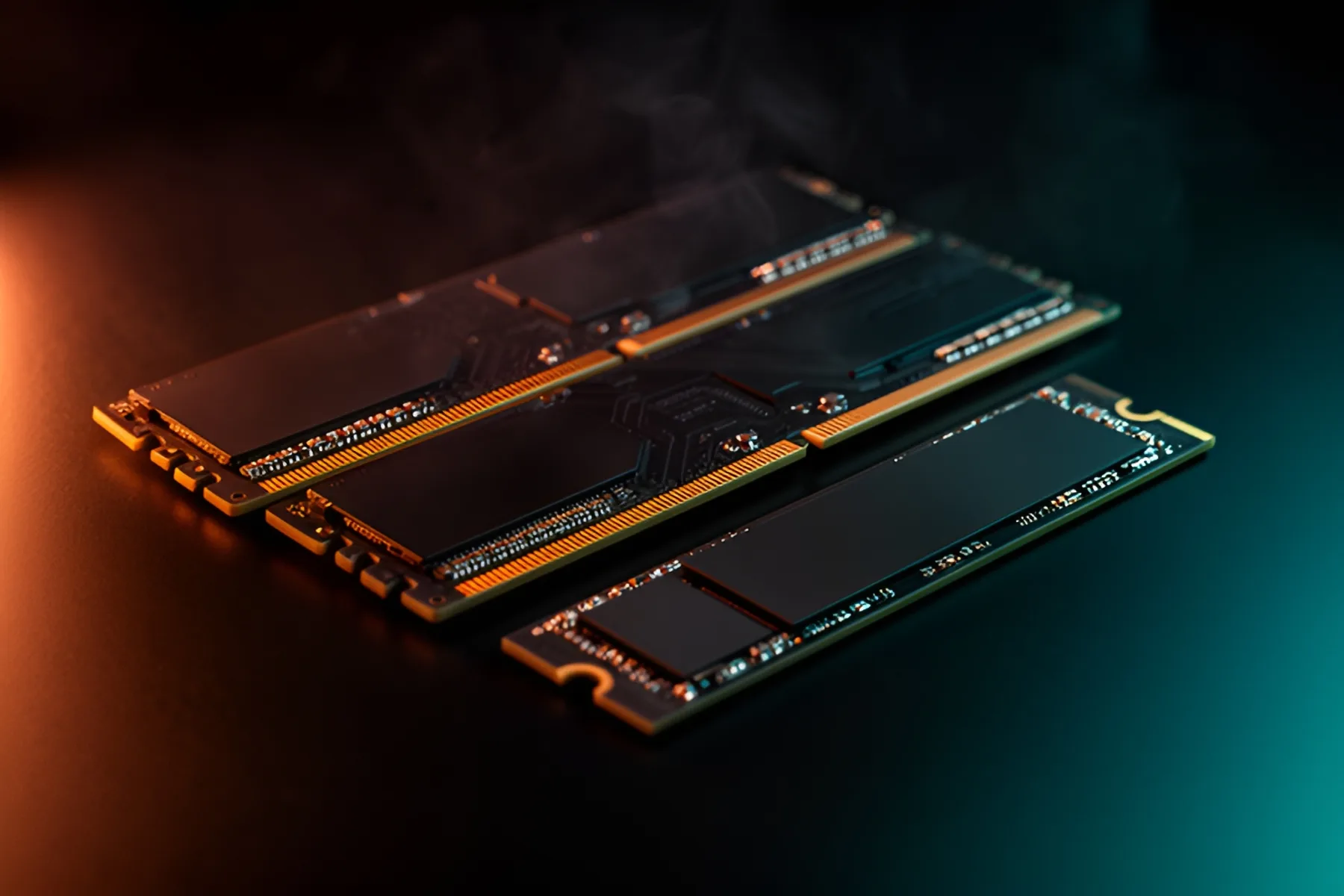
DDR5 kits and SSDs cost far more than they did at launch, and the reason is a buyer you can't outbid. Memory makers are selling their output to AI data centers, which pay more and sign longer contracts than PC builders do. People have taken to calling it the RAMpocalypse. Here is what caused it, what is still disputed and how to buy around it.
AI data centers took the wafers
A memory factory can only start so many silicon wafers, and the memory on AI accelerators is far hungrier for them than the memory in your PC. High-bandwidth memory, or HBM, stacks DRAM right beside the processor. Coverage of Micron's December 2025 earnings call put it at about three times the wafer area of DDR5, so a wafer moved to HBM yields roughly a third as many gigabytes.
Customers worried about long-term access have been signing multi-year supply deals, and at the end of 2025 Micron said it could meet only half to two-thirds of demand from its key customers.
The forecast has not improved. On its fiscal 2026 earnings call this fall, Micron said it expects a tighter market in 2027 and 2028 than in 2026, that most of its output for next year is already sold, and that it can't see when supply and demand will come back into balance. Output is growing, with Micron expecting DRAM and NAND shipments to rise by a low-to-mid-20s percentage in each of the next two years. HBM is taking priority over conventional DRAM in that growth.
New factories take years. As of its December 2025 call, Micron expected the first of two new Idaho fabs to start producing chips in mid-2027, with a planned New York site following around 2030.
SSDs caught the same wave
SSDs use NAND flash rather than DRAM, but the same small group of companies makes it, and AI servers need enormous amounts of storage. In January, a Kioxia managing director said the company's production for the year was already sold out and that cheap 1TB drives were finished for as long as the AI boom lasts, and Tom's Hardware reported that the supply was likely spoken for through 2027 as well.
The damage reached every kind of drive. Tom's Hardware's price tracking from November 2025 to January 2026 showed double- and triple-digit percentage jumps across SATA, PCIe 3.0, PCIe 4.0 and PCIe 5.0 models, in just a couple of months.
One big consumer brand is leaving
In December 2025, Micron said it would wind down Crucial, its consumer memory and SSD brand sold to PC builders since 1996, and stop supplying retailers after late February 2026. It said it would keep honoring warranties on existing products, and it still supplies DRAM for PCs through other companies. Its stated reason was to free up supply for larger customers in faster-growing segments.
For you, that means one fewer large brand competing for your money at the affordable end. Our catalog still shows some of its kits and drives on sale this week.
Not everyone accepts the long forecast
Acer CEO Jason Chen argued in September that memory makers talk up the shortage to protect their margins. He expects PC prices to keep rising through the end of this year, level off in the first half of 2027 and then fall as cheaper capacity from Chinese memory makers comes online.
Micron's forecast points the other way, and each side has a stake in the answer. Micron profits from scarcity, and Acer sells more PCs when parts are cheap. We can't tell you who is right. Treat any end date you read, including these two, as a forecast from an interested party.
What to do if you are buying
Plan around today's prices and these five rules.
- Keep the memory you have. If you own DDR5, build around it. As of November 9, several 32GB DDR5-6000 kits in our memory category cost more than a Ryzen 7 9800X3D.
- Buy the right amount once. For a new gaming PC, 32GB is the target. If the budget forces 16GB, buy a two-stick kit and plan to replace it later, because adding a second pair usually makes DDR5 run slower.
- Skip speed you won't notice. DDR5-6000 is plenty for most gaming builds, and enabling its profile costs nothing. For storage, choose capacity first, then compare price per terabyte across our SSD listings.
- Price a prebuilt before parts. System builders bought memory earlier and in bulk, so some prebuilts now undercut the same parts bought separately. Our prebuilt vs custom guide shows how to compare them fairly.
- Buy from sellers with a real return policy. Shortages attract counterfeiters, so skip marketplace listings with no history.
If you are still deciding whether to buy at all, use our framework for building right now.
Common questions
When will RAM prices go back to normal?
Nobody knows. Micron said this fall that it expects tighter supply in 2027 and 2028 and can't see when the market will balance, while Acer's CEO expects PC prices to fall from the second half of 2027. Plan around today's prices rather than a date.
Why are SSDs expensive if they use different chips than RAM?
SSDs use NAND flash instead of DRAM, but the same small group of companies makes both, and AI servers need huge amounts of storage. Kioxia said in January that its output for the year was already sold. Prices rose across SATA and NVMe drives alike.
Will my warranty still work on memory from Micron's consumer brand?
Micron said it would keep honoring warranty obligations and providing technical support on existing consumer products after shipments end. Keep your proof of purchase, as you would for any warranty claim.
Is 16GB of DDR5 enough for now?
It will run most games and everyday software, but 32GB is the better target for a new gaming PC. If the budget forces 16GB, buy a two-stick kit and expect to replace it rather than add to it, because four sticks of DDR5 usually run slower than two.
Are prebuilt PCs really cheaper than building right now?
Some are. System builders bought memory earlier and in bulk, so certain configurations cost less than the same parts bought separately. It varies a lot, so compare the named parts and check that the motherboard, power supply and case are standard.
Sources
- Micron projects tightening RAM shortages through 2028 as it generates record profit — record 86.25% gross margin drives over $53 billion in quarterly profit · Tom's Hardware
- Micron outlines grim outlook for DRAM supply in first earnings call since killing Crucial memory and SSD brand — CEO says it can only meet half to two-thirds of demand · Tom's Hardware
- Micron is killing Crucial SSDs and memory in AI pivot — company refocuses on HBM and enterprise customers · Tom's Hardware
- Kioxia exec says the AI boom means the era of the cheap 1TB SSD is over —company's NAND supply is sold out for this year and likely through 2027 · Tom's Hardware
- Acer CEO says memory makers are hyping 2030 shortage fears to protect margins — PC prices set to decline by late 2027, cheaper Chinese capacity coming online delivers lower memory prices · Tom's Hardware
R8Keep reading
Guides · 7 min
Prebuilt vs Custom PC in 2026: When Each One Wins
Memory prices have changed the math. Learn when a prebuilt beats building your own, and how to spot weak parts hiding in any spec sheet.
Nov 9, 2026
Guides · 5 min
How Much RAM Do You Need in 2026?
16 GB is the floor and 32 GB is the target. Choose capacity, DDR5 speed and kit layout, and find out how to buy while memory prices are this high.
Nov 9, 2026
How-To · 4 min
How to Enable EXPO or XMP
Turn on your RAM's rated speed in the BIOS, and know what to do if the first boot takes minutes or the system turns unstable afterward.
Nov 9, 2026
Bench Notes
One short email a week: price drops worth acting on, launches that matter, and the builds we would actually buy.